field report
Inside a Club Run: Four Days on a Winery Packing Line
Four days inside a club run, from the Monday pick list to the last carrier manifest of the week, including the exception cart where refusals, breakage, and address rewrites quietly pile up.

Monday: the pick list, the reserve, and what already went wrong
A club run at a small winery starts with the pick list. This is not a spreadsheet for the shelf, but a living document that reveals the first day's headaches. Released from the member management system before opening, the pick list tells the warehouse crew what bottles to pull, where they will go, and which special holds or substitutions must be flagged.
Monday morning brings a rush. The reserve rack is checked for library reds, limited chardonnay, or the magnum that goes only to top-tier members. If a member requested a hold, or there is a note about heat shipping bans, the crew must spot it now, not after packing. A well-prepared pick list includes these notes, but if the member record is out of date, a bottle can move down the line only to get stopped later.
Already, things go sideways. Maybe the 2018 cabernet that was promised is down to the last two cases, but the list calls for twelve. Substitutions start. A member's address bounces against last month's UPS return, but the change never made it to the list. The manager decides: either pause the shipment or try to reach the customer. The pick list gets marked up in pen and the day's rhythm is set.
Keep reading: How One Winery Rebuilt Its Summer Club Shipping Window
How a pulp insert is loaded, closed, and taped on a real line
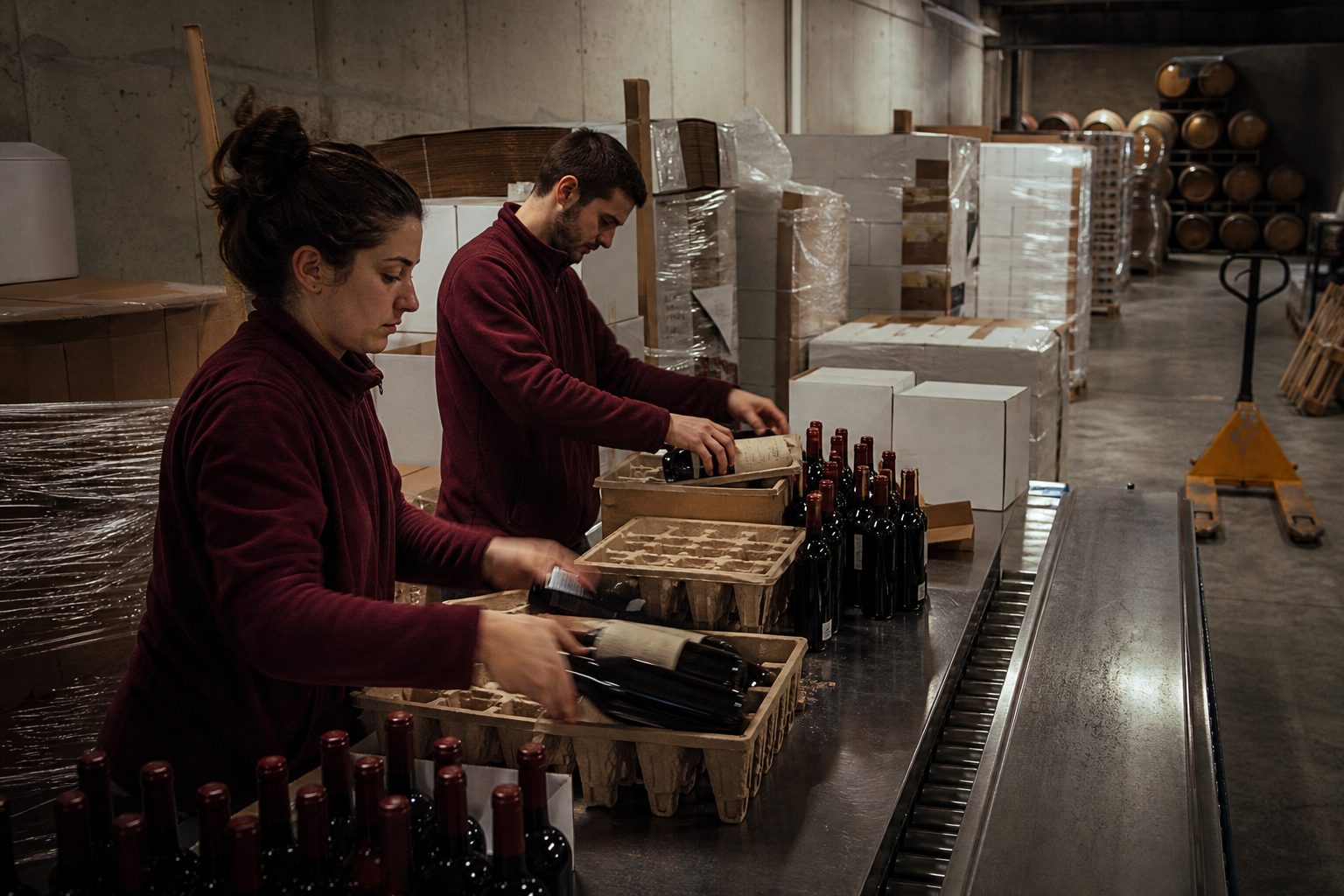
On the packing line, the first task is setting up the shipping boxes. Most small wineries use molded pulp inserts. These cradle two, four, or six bottles and offer basic protection against breakage. Crews work on folding tables, often in a converted barrel hall, with stacks of flat boxes and wrapped pulp trays.
Box Prep and Bottle Handling
Boxes are folded and lined with pulp inserts. Bottles are checked for leaks or label damage before packing. Each bottle is handled twice: once to confirm the correct varietal from the pick, and again to place it upright in its slot. A distracted crew member can grab the wrong vintage, so the pick list follows the box down the line, checked off bottle by bottle.
For mixed shipments, it is common to sort bottles in advance. The crew lines up the day's club allocations, then passes them down the table. A scanner is sometimes used to double-check labels, but many crews work by eye, especially with custom club selections.
Closing the Box
After loading, the top pulp insert goes on. The box is closed and taped, usually with a handheld dispenser. Some wineries double-tape the bottom flaps if a carrier flagged their packaging before. The tape is pressed down along the seams, and the weight of the full box is checked by hand. Anything that rattles or shifts is repacked.
A finished box moves to the next station, but the crew's pace depends on the number of special requests, not just the order size. A one-off gift note or a signature-required sticker can slow the entire line if not caught early.
The compliance stop between the pick face and the label printer
Before a shipping label is printed, every box must clear a compliance checkpoint. This step is where paperwork and regulation meet the wine. The compliance stop checks that the shipment follows state rules: bottle limits per consumer, dry area restrictions, and adult signature requirements.
Most wineries use software that checks member addresses against state lists. If a member in Alabama tries to ship a case, the system halts the label. Some states require specific label wording, while others have excise tax paperwork that must be attached. The compliance stop is the last chance to get this right before the package leaves the building.
If a compliance block pops up, the box is pulled off the line. Sometimes it is a simple fix: swap out a 750ml for two half bottles to meet a volume limit. Other times, the shipment must be canceled or rerouted. The member is notified, and the box waits on a side cart for resolution.
This step has saved many wineries from fines or rejected shipments. It also slows down the process, especially when club runs overlap with direct-to-consumer orders or tasting room sales. A single shipment to a new state can hold up the whole day if the compliance database is out of date.
Keep reading: DTC Wine Shipping in the Next Five Years: What to Watch
Carrier pickup windows and the last manifest of the day
Once boxes are packed and cleared for compliance, shipping labels are printed. Most wineries work with common carriers like UPS or FedEx, which set strict pickup windows. The pressure builds throughout the afternoon. The carrier truck arrives at 3 p.m., and the cut-off for label printing is often fifteen minutes before.
The packing crew stacks finished boxes on pallets or rolling carts, sorted by carrier and service level. Each box is scanned into the carrier's system, generating a manifest. The manifest is both legal documentation and the record that the shipment is now in the carrier's hands, not the winery's.
Late boxes sometimes miss the truck, especially if a label reprint or compliance hold delays them. In those cases, the box is set aside for the next day's pickup. The manifest closes with the carrier's signature, and any box not scanned is the winery's responsibility until it leaves the dock.
Some wineries try to squeeze in last-minute pickups, but most have learned not to risk it. A missed carrier window can mean a day's delay, which in summer shipping means lost wine or a disappointed member.
The exception cart: refusals, damages, and address rewrites
The clean flow of a club run hides the reality of the exception cart. Every winery has one: a rolling cart or a corner table piled with boxes that could not ship. These are the problem children of the fulfillment process.
Refusals and Returns
Some members refuse a shipment after it is packed, asking to skip a release or hold for cooler weather. The box lands on the exception cart while the staff sorts out a refund or a new shipping date. If a carrier returns a box for an undeliverable address, it ends up here too. These boxes must be unpacked, bottles inspected for damage, and inventory returned to stock.
Damages and Breakage
Damaged boxes are a daily problem. Bottles break in transit or during handling. When a box comes back wet or with broken glass, the entire shipment is flagged. The crew must photograph the damage, document the lot numbers, and file claims with the carrier. Replacement orders are created, usually with a note to pack extra carefully or use additional inserts.
Address Rewrites and Member Updates
Address issues are another cause for exception. Members move, change apartments, or mistype their address in the system. The crew spends time calling or emailing the member to confirm the new details before the box can go out again. Sometimes this takes days, and boxes stack up as the club run continues.
The exception cart is never empty. It is the visible reminder that fulfillment is not just about speed, but about follow-up and recordkeeping.
See how CellarShip handles this for wineries
Will call, pickup party staging, and the local delivery run
Not every club member wants their wine shipped. Will call orders , where members pick up at the winery , add another layer to the run. Some members stop by during normal hours, but others expect their box to be ready for a weekend pickup party.
The crew sets aside will call boxes, labeling them by member name and club tier. For large pickup parties, the tasting room and warehouse coordinate to stage hundreds of boxes for quick handout. This includes checking IDs, matching orders to signatures, and handling any special requests or substitutions on the spot.
Some wineries offer local delivery, either with their own van or a courier service. The process mirrors the shipping run, but with more direct contact: delivery slips, signature collection, and sometimes the challenge of arranging delivery windows. Local deliveries may also involve temperature-controlled vehicles in hotter months.
If a will call order sits unclaimed for too long, the crew contacts the member and sometimes offers to ship the box, especially if warehouse space is tight. Each uncollected box is another item to track in the system.
What the packing crew wishes the tasting room understood
The most efficient club runs depend on clear communication between the tasting room, the club manager, and the packing crew. Too often, the information flow breaks down after a long weekend of signups.
Accurate Records Mean Fewer Delays
Packing crews depend on up-to-date member records. When a tasting room host promises a specific wine or takes a handwritten address correction, that information needs to reach the system before the club run. Outdated records are the main cause of exceptions and repacks.
Special Requests Add Up Fast
Gift notes, substitutions, and last-minute holds sound simple from the tasting bar, but create real work on the line. Each special request is a chance for error if not logged correctly. The crew wishes tasting room staff would flag these requests clearly and early.
Timing Matters
The timing of new signups and club holds affects fulfillment. If tasting room staff can batch updates and communicate them before Monday, the week's run goes smoother. Otherwise, the crew spends extra hours sorting out changes that could have been resolved in advance.
Packing teams do not expect the tasting room to handle logistics, but a little extra attention to the handoff makes a big difference during crunch time.
In the end, the smoothest club runs rely on strong records, clear communication, and tools that track member preferences, shipment allocations, and compliance rules in one place. A member management platform with built-in shipment holds and per-state checks can take much of the friction out of club fulfillment, letting the packing line focus on the wine rather than the paperwork.
Read also
How One Winery Rebuilt Its Summer Club Shipping Window
A July heat wave, a weekend spent in a hot trailer, and a run of cooked bottles. How one estate rebuilt its ship days, its hold triggers, and its member notices before the next summer run.

DTC Wine Shipping in the Next Five Years: What to Watch
State direct shipping bills, retailer shipping litigation, carrier surcharges, and a generation drinking less. What a small winery should decide this year and what it can safely leave alone.

How to Allocate a Small Lot Release Across Your Club Tiers
Cases available, tier ranking, pro rata math, wait lists, offer windows, and the release of unclaimed bottles. A working method for splitting a small lot across a club without losing the list.