numbers and benchmarks
What a Three-Bottle Club Shipment Costs to Pack and Ship
Shipper, insert, freight zone, residential surcharge, adult signature, pick and pack, card fees, and reships. How to build a cost per box figure you can actually defend to a partner.

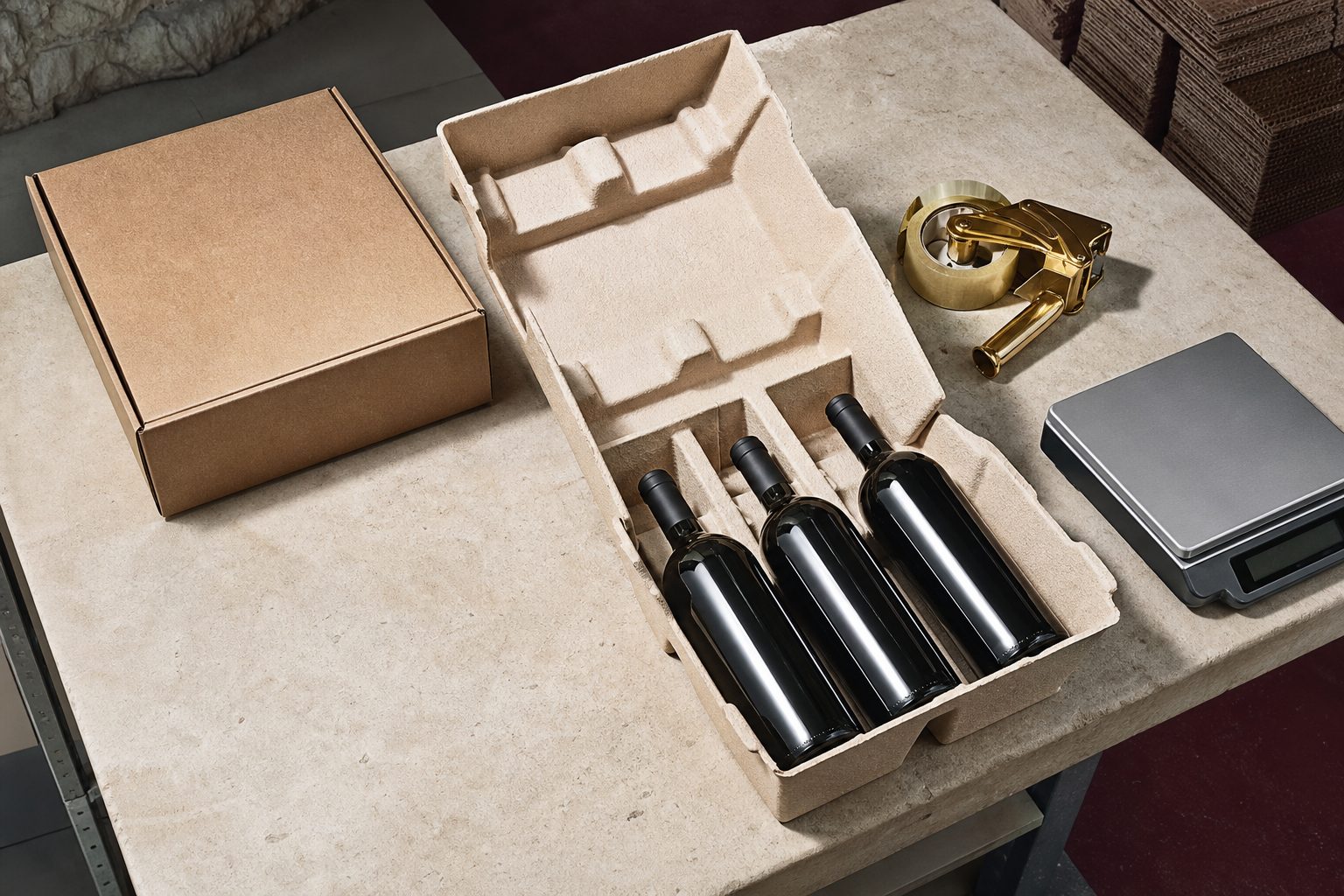
The line items that add up to a landed cost per shipment
Every wine club shipment that leaves your packing area carries more cost than just the bottles inside. For a typical three-bottle club box, the list starts with the shipper itself and anything you add to cushion or present the wine. There are labor costs for assembly and fulfillment. Then come postage, adult signature charges, credit card fees, and the expense of dealing with failures such as returns and reships.
To build a cost you can defend, you need to account for each of these categories as a line item, not guesswork. Some are predictable: the cost of a molded pulp shipper or a printed insert. Others, such as reships or card declines, are less regular but real. Each cost belongs in your model.
This section lays out the categories you must track to know what each shipment truly costs. The next sections explain how to estimate or calculate each one, and where benchmarks stand for wineries of your size.
Keep reading: The Club Shipment Errors That Cost You Members and Wine
Molded pulp shippers, inserts, and the case pack math behind them
The box you choose for your wine club shipments is more than a container. It is insurance, branding, and compliance all at once. Most small wineries use molded pulp shippers, which provide good protection and are accepted by carriers. There are also foam, cardboard, and hybrid options, but molded pulp sets the standard for balancing cost and performance.
The cost of the shipper itself
Single three-bottle pulp shippers can be bought by the case or pallet. Per-unit price drops as your order size increases. The price difference between ordering 40 shippers at a time and a full pallet of 240 can be significant. Larger wineries may even get truckload rates, but most small wineries work by the case or half-pallet.
You also need to count the cost of tape, labels, and any custom branding you apply. Inserts such as tasting notes, coupons, or club letters add to the per-shipment cost, even when printed in bulk. Box inserts are often overlooked in cost models, but printing, folding, and stuffing each one takes both money and labor minutes.
Case pack math and spoilage
Shippers come in cases: ten to twelve three-bottle packs per case is common. If you ship other sizes, you may end up with leftover inserts or odd lots. Inventory spoilage, damaged or obsolete packaging, should be included as a percentage of your packaging budget. A conservative approach is to set aside a portion of your packaging spend for these losses.
Freight zones, dimensional weight, and residential delivery surcharges
Shipping cost is the single largest line item for most wine club shipments. It is determined by more than just the physical weight of your box. Carriers such as UPS and FedEx use a pricing approach called dimensional weight, which means the size of your shipper matters as much as its mass.
Freight zones and rate tables
Carriers divide the United States into zones. The further your shipment travels, the higher the zone and the higher the cost. For small wineries, shipments may cluster in a handful of states, but most clubs have at least a few members in higher-rate destinations. Carrier rate tables show the cost for each zone and are updated each year. Building your cost model means knowing your shipment mix by state, then weighting the average shipping cost accordingly.
Residential surcharges
Almost every wine club shipment goes to a home, not a business. Carriers charge a residential delivery fee on top of the base rate. This fee is non-negotiable and appears on your invoice for every residential address. Do not average this fee across all shipments, apply it to every box unless you know otherwise.
Dimensional weight in practice
A three-bottle shipper, with inserts and padding, often triggers a higher billed weight than the physical weight suggests. Measure the external dimensions of your packed box, multiply length by width by height, and divide by the carrier's divisor to get the billed weight. This is the number you use in the carrier's rate table, not the weight of the wine itself.
Some carriers also apply fuel surcharges. These are variable and announced monthly or quarterly. You can estimate them as a percentage of base shipping cost, but check current rates each season and adjust your model.
Keep reading: Fixed Selection, Member Choice, or Credit: Club Models Compared
The adult signature fee and exactly what it buys you
Wine is a controlled product. Federal law and carrier policy require that every wine club shipment be signed for by someone twenty-one or older. Carriers charge an adult signature fee for each package, separate from the freight cost. This fee pays for the carrier's compliance process: verifying identification at the door, capturing a signature, and recording the delivery attempt.
The fee is per box, not per order. If your club member receives two separate shipments (for example, a gift order and a club box), you pay twice. The adult signature service does not guarantee delivery, if no adult is home, you may face further fees for reattempts or returns.
What you get for this cost is legal compliance and the ability to keep shipping wine. Skipping this fee is not an option. Most carriers will not process wine shipments without it, and you risk fines, penalties, or losing your shipping account if you attempt to bypass the requirement.
Pick and pack rates: per order, per bottle, and per touch
Packing wine club shipments is labor-intensive. For a three-bottle club, the process includes picking the bottles, assembling the shipper, packing the wine, adding inserts, labeling, and sealing the box. Some wineries do this in-house with their tasting room or warehouse staff. Others outsource to a third-party fulfillment house.
In-house labor costs
If you use your own team, calculate the cost by tracking the minutes spent per box and multiplying by your loaded labor rate (wages plus payroll taxes and benefits). Some clubs can pack 20 boxes per hour with two staff, but this varies with experience, bottle sizes, and the complexity of inserts. Do not forget to include setup and cleanup time, breaks, and any time lost to errors or rework.
Third-party fulfillment rates
Fulfillment providers charge by the order, by the bottle, or by the touch (each item added to a box). Typical structures might look like a base fee for each order, plus an additional amount for each bottle and insert. Some fulfillment houses charge separately for packing materials, storage, or special handling such as seasonal ice packs.
When comparing in-house and outsourced fulfillment, include all overhead: space, utilities, and management time. True cost-per-box is always higher than just direct labor or the pick fee.
See how CellarShip handles this for wineries
Card processing, declines, and the real cost of a retry cycle
No shipment leaves unless the member's payment goes through. The payment processor takes a percentage of every successful transaction, plus a flat fee per charge. For wine clubs, the transaction amount is often in the $60 to $150 range for a three-bottle box, depending on wine price and shipping charges.
Card decline rates and recovery
Every club cycle, a percentage of cards on file will decline. Reasons include expired cards, fraud blocks, or insufficient funds. Each decline triggers a retry cycle: contacting the member, requesting updated information, retrying the charge, and sometimes manual intervention. This cycle takes staff time and can delay shipment, add customer service workload, and occasionally result in a lost club member.
Each retry attempt incurs processing costs and, in some cases, additional fees from your card processor. If you retry a failed card three times and then switch to manual collection, you have accumulated both direct and indirect costs. These should be tracked per shipment, not just as a general overhead.
Chargebacks and disputes
Chargebacks (when a member disputes a charge) are rare in clubs but do happen. Each chargeback carries a fee and often results in lost product, lost shipping, and staff time spent on the response. For accurate modeling, include a small per-shipment allocation for the cost of disputes, even if they are infrequent.
Reships, refusals, breakage, and returns as a standing budget line
Not every wine club box arrives on the first try. Some are refused, some are returned to sender, and some are damaged in transit. Each of these failures adds cost, both in lost product and in the labor needed to correct the problem.
Reships and refusals
If a box is refused or not delivered after multiple attempts, carriers return it to your facility. You are charged for the return shipping, and you may have to pay again to reship to the member's updated address. Some clubs choose not to reship, instead offering a refund or credit. Either way, the cost is material.
Breakage in transit
Broken bottles are rare but not unheard of, especially in summer or with certain shippers. Replacing a broken shipment means eating the cost of wine, packaging, and shipping a second time. Carriers offer declared value coverage, but it rarely covers full retail or club value, and claims can be slow to resolve.
Returns and inventory shrink
Returned wine often cannot be resold, depending on state law and your quality standards. Some wineries use returned bottles as samples or tasting room pours, but the revenue is lost. You should budget for returns and shrink as a percentage of total shipped volume, based on past years' experience.
Turning the pieces into a cost model you update each season
To build a defensible cost per shipment, list each of the categories above on a worksheet. Assign a dollar amount to each, based on your most recent invoices, payroll records, and shipment history. For variable costs, such as shipping and returns, use a weighted average based on your actual delivery addresses and recent incident rates. For labor and fulfillment, include all overhead and not just direct wages.
Total these figures for an all-in landed cost per three-bottle club shipment. If you want to express the cost per member, multiply by the number of shipments per year. For forecasting, review and update each input at least once per season: shipping rates change each spring, packaging costs move with supply chains, and member behavior shifts over time.
A cost model built this way lets you defend your numbers to partners, explain your pricing to members, and plan for growth. Managing the details is easier with a dedicated club management tool that tracks orders, holds, compliance, and costs for each shipment. The right system makes seasonal updates to your cost model part of the routine workflow.
Read also

The Club Shipment Errors That Cost You Members and Wine
Most club failures are process failures: billing before the change window closes, shipping into a heat wave, mishandling a skip, and packing a wine the destination state has never seen.
Fixed Selection, Member Choice, or Credit: Club Models Compared
Fixed selection, member choice, credit on account, and allocation lists each shift work between your cellar, your tasting room, and your fulfillment desk. Here is where each one costs you.
Inside a Club Run: Four Days on a Winery Packing Line
Four days inside a club run, from the Monday pick list to the last carrier manifest of the week, including the exception cart where refusals, breakage, and address rewrites quietly pile up.